

How Does Soil Filter Groundwater
How Dirt Cleans Water
A purified projection from Science Buddies
Cardinal concepts
Filtration
Aquifers
Permeable and impermeable soil
Groundwater
Introduction
Have you always noticed the claim on a bottle of water that it contains "spring water"? More than half of the bottled h2o sold in the U.Southward. is labeled this way, but merely a fraction of this h2o really flowed naturally from a leap. About is from groundwater that is sucked up by pumps (which are installed near a bound). In 2014 this was most 22.vii billion liters of water. That is a lot of water! Y'all might wonder how water is stored undercover—and what replenishes these reservoirs. In this activeness you lot will create a model, fill up three reservoirs and evaluate how clean the h2o in these reservoirs becomes. Will your "groundwater" be as tasty as spring water? Try this activity to find out!
Background
Imagine a rainstorm has merely come through; some water runs downwards the pavement and into a patch of grass where some of it soaks into the footing. Where does that water go? When water soaks—or infiltrates—into a permeable soil, it makes its way through the spaces between the particles in the soil. Soil with larger particles has larger holes, resulting in fast-draining water. Soil with small-scale particles drains water more slowly. Some soils, such equally clay, make information technology very hard for h2o to seep through and are near impermeable. Ground such every bit granite is impermeable. Water flows over the particles into cracks but cannot go through the particles.
As water seeps deeper into the ground, it will eventually accomplish an impermeable layer and either collect or period sideways. This creates underground layers of permeable soil that are saturated with water. Saturated basis has all its holes or pores filled with water. These layers are called aquifers, and they can exist small or massive. The largest aquifer in N America (the Ogallala) runs from South Dakota all the fashion south to Texas.
Dissimilar surface water nerveless in rivers and lakes, groundwater is frequently clean and ready to potable. This is because the soil actually filters the h2o. The soil can hold onto pollutants—such every bit living organisms, harmful chemicals and minerals—and only let the make clean water through.
Materials
- Virtually 500 milliliters (one pint) of h2o
- Pot that can hold a little more 500 milliliters
- Ruddy food coloring, preferably liquid (Carmine, flavored-potable powder also can be used.)
- Cacao pulverization (one tablespoon)
- Coarse footing black pepper (one half tablespoon)
- Spoon
- Three empty 500-milliliter disposable water bottles with lids
- Pair of scissors
- Popping corn kernels (unpopped)
- Cornmeal
- Cornstarch
- Three tall glasses (Preferably they should be spectacles with a rather narrow opening so that an upside-down water bottle tin can rest in each glass's opening.)
- Ane-quarter cup measuring cup
- Workspace that tin can tolerate some liquid splashes
- An developed helper
Preparation
- Pour nigh 500 milliliters of water into a pot. Add 2 drops of carmine nutrient coloring or some of the cherry, flavored-drinkable pulverisation, one tablespoon of cacao powder and half a tablespoon of fibroid footing black pepper. Mix well. This will serve as your "dirty" h2o.
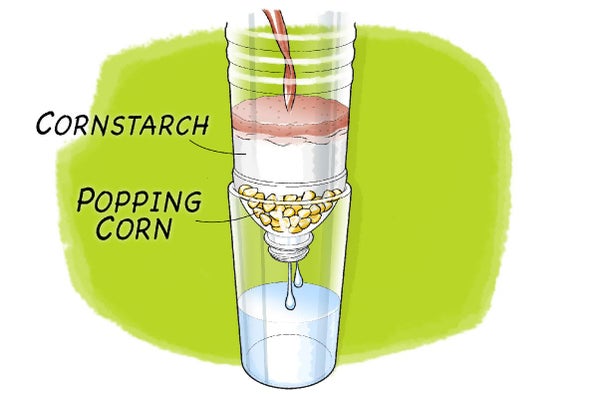
- To create your 3 soil containers, have an adult carefully help you cut off and discard the bottoms of three empty h2o bottles. Turn the tops upside downward so they look like elongated funnels. Leave the bottle caps on and let the funnels rest in the glass openings.
- Make full the funnel part of each soil container with popping corn kernels. The kernels stand for pebbles in nature.
- Add a 2.5-centimeter (one-inch) layer of cornmeal on top of the layer of popping corn in one soil container, which represents coarse sand in nature.
- Add a 2.5-centimeter layer of cornstarch on summit of the layer of popping corn in the second soil container, which represents claylike soil in nature.
- Add a 2.5-centimeter layer of popping corn to the third container. All three containers should at present have the same level of "soil". Which "soil" do you wait volition allow the water to seep through fastest?
Process
- Stir your dirty water well.
- First, wet the surface of the soils by pouring four tablespoons of dingy water over the soil in each of the 3 containers. Await at the side of the soil containers. Tin can yous meet how high this water reaches? Is information technology the same for all three containers?
- Scoop out one-quarter cup of dirty water and cascade it over the soil in one container. Watch what happens. Does water collect at the bottom of the funnel? Does information technology run fast or slowly through this soil?
- Repeat the previous step for the second soil container and then for the third i. Remember you lot predicted which "soil" would allow h2o to seep through fastest. Was your prediction right? Why do you lot retrieve this soil drains water fastest?
- The water volition collect at the bottom of the funnel, where it is stopped past the canteen cap (an impermeable layer). This is similar an aquifer, an underground layer of soil saturated with water. Soil in which all the holes between particles are filled with water is called saturated. Compare how fast the aquifer grows in the iii containers.
- While you wait for the water to seep through the "soil," reverberate on the following questions: Which of the three "soil" types has bigger holes between the particles, the corn kernels (pebbles), the cornmeal (sand) or the cornstarch (clay)? Could that explain why some "soils" allow h2o to seep through more than quickly than others?
- Yous poured the same amount of water on the three soil containers. Practice y'all retrieve that if you wait long enough, the three aquifers will eventually hold the aforementioned amount of water or will 1 agree more than another? Why exercise you lot think this is the instance?
- In a moment you will (or a helper an developed to) unscrew the bottles and collect the h2o gathered in the aquifer in the glasses. What practise you await the muddy water to be like afterwards it runs through each type of "soil"? Would any pollutants get stuck in the dirt and thus exist filtered out? Would the different "soils" take unlike abilities in filtering your dirty water?
- At present, unscrew (or enquire an adult helper to unscrew) the bottle cap at the bottom of the corn kernel simply soil container. Pay attending; your aquifer volition instantly deplete. Ask the developed to collect as much of the water equally possible in the alpine glass on which the container was resting. When done, replace the unscrewed container on the tall glass then more h2o can drip out. Note some corn kernels might drip out; this is fine.
- Now repeat (or ask an adult helper to repeat) the previous pace for the other ii containers.
- Examine the water that ran through the "soils." Did running the dirty water through "soil" remove the red food coloring?
- Taste the original dingy water and the post-filtered water. Does it taste different? Did any of the "soil" filters remove the cacao powder?
- Look carefully at the bottom of the glasses for signs of blackness pepper. Did any of the "soil" filters remove the black pepper?
- Actress: Let your bottles drain over a longer period of time. Did more h2o bleed through i "soil" type compared with another? Would this imply that some types of soils retain more h2o than others?
- Extra: Try a thicker layer of soil. Would a thicker layer of soil be able to filter out more pollutants?
- Extra: Repeat the activity with gravel, sand and clay. Wash the gravel before you start, only definitively do not sense of taste the water collected in the glasses!
Observations and results
Did you notice how the aquifer in the container with simply corn kernels (pebbles) filled almost instantly whereas the one with a layer of cornmeal (sand) filled slower and the one with a layer of cornstarch (clay) took a long time?
This is to exist expected. The larger holes betwixt the kernels (or pebbles) permit water to seep through quickly—the water drains fast. Cornmeal has smaller particles, simply like sand. These particles pack close together and leave little holes in between. The h2o can still seep through only takes a trivial longer. Cornstarch is similar to clay. It consists of very pocket-size particles packed closely together. The h2o has a very hard time getting through this material.
Did you too detect the kernels merely filtered out black pepper whereas the cornmeal filtered out most of the cacao powder and a little bit of the food coloring, too? If y'all were patient, y'all could see that the cornstarch filtered out all the cacao power and more food coloring. This is similar to what happens when dirty rainwater seeps through the soil and gathers in an aquifer. The soil filters the muddy water. Contaminants get stuck in the soil, and clean h2o reaches the aquifer.
Although groundwater is usually clean, soils are non perfect filters. Some contaminants still make their way through the soil and contaminate the groundwater. This is a serious trouble; once polluted, it is hard to make clean an aquifer.
Cleanup
The content of the soil containers can go into the composting bin. The plastic bottles can be recycled.
More to explore
Capable Carbon Filter, from Scientific American
Aquifer, from National Geographic Society
Pollution of Ground Water, from Water Encyclopedia
This activity brought to you in partnership with Science Buddies


How Does Soil Filter Groundwater,
Source: https://www.scientificamerican.com/article/how-dirt-cleans-water/
Posted by: mallarduntes1948.blogspot.com
0 Response to "How Does Soil Filter Groundwater"
Post a Comment