

What Animals Can You Hunt With 6.5 Creedmoor
Debates rage; red-eyed, froth-mouthed opinions potent. Is the 6.5 Creedmoor a nifty big-game cartridge? It's the wildly pop protégé cartridge of the 21st century, only is it skillful at harvesting big-game animals? Comparative literature abounds; 6.5 Creedmoor versus .308 Winchester, vi.five Creedmoor versus .30-06 Springfield, 6.5 Creedmoor versus .243 Winchester. Interesting stuff, to exist sure, only not what this commodity is about. This article is about how well (or not) the half-dozen.five Creedmoor performs on large game.
Now, dead is expressionless, and no cartridge can kill a big-game animal "deader" than a different cartridge will. What it can practice, however, is kill it more efficiently, more finer and more cleanly.
I've seen a plethora (can I say plethora? I recall I can say plethora … ) of big-game animals taken with the half-dozen.5 Creedmoor. Having witnessed these kills—along with a debacle or two involving said cartridge—I feel qualified to pontificate upon its "deadliness gene." Though I have personally harvested simply two animals with the cartridge, in the interest of our give-and-take I'll include those personal experiences, fifty-fifty though one, unfortunately, resides in the debacle category.
The detailed accounts below will feature pertinent information; including shot angle, yardage, projectile used and more. I'll describe the course of each issue, and finish up with details on final performance. So pour a cup of coffee, settle into your favorite chair and boot your feet up—this is about to get interesting.
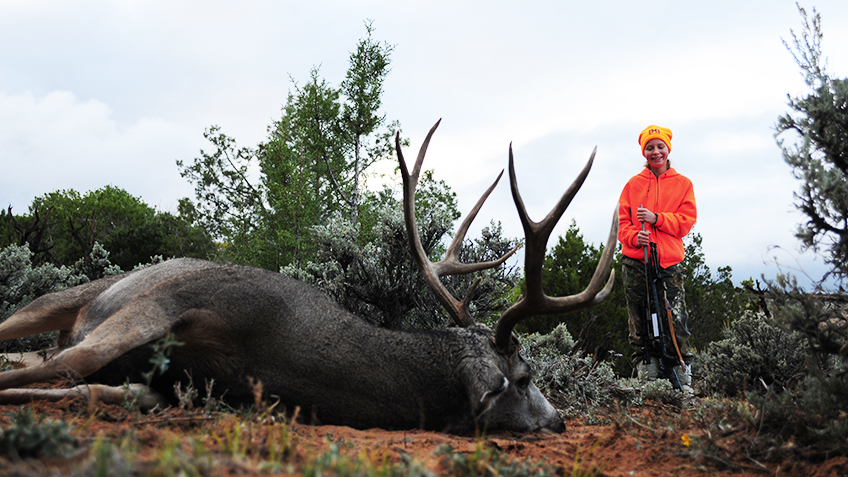
Mule Deer, 386 Yards
• Angle: broadside
• Bullet: 140-grain Hornady A-Max
• Air current: 10 mph, nine o'clock
My then-12-year-old girl lay abdomen-down atop a sandstone outcropping, a big buck in her crosshairs. We were iv difficult-hunted days into her first mule deer hunt, and she was prepare to accept this long shot, having trained hard and competed well in a long-range cross-land competition a couple months prior. I made a air current call, she pressed the trigger, and four jumps after the large muley lay still in the desert sage. I couldn't have pinpointed the desired shot placement meliorate with a Sharpie. The bullet entered a tertiary of the way up the body at the back edge of the shoulder, traveled straight through, and stopped just under the deer's hibernate on the opposite side. Information technology was perfectly mushroomed and left a meaning—though not unholy—path of destruction in its wake. Upon bear upon, the buck made four feeble jumps and went downward. Approximately 3 seconds elapsed between impact and collapse.
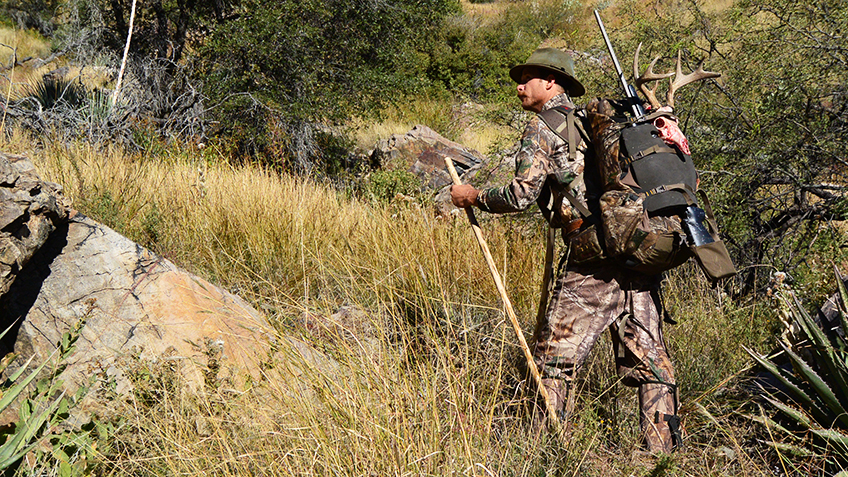
Coues Deer, 290 Yards
• Bending: very slightly quartering, almost broadside
• Bullet: 140-grain Hornady A-Max
• Current of air: negligible
Five tortuous hours lying prone atop a pile of precipitous Arizona rocks preceded this shot. I'd spotted the buck from 1.v miles away that morning and airtight the distance as much equally I dared to cover the spot I reckoned he bedded. Just earlier dark, he appeared, motionless, in a thin screen of tall yellowish grass. He was steeply to a higher place me, and then my bullet entered low just in front of the shoulder crease, and stopped, perfectly mushroomed, under the pare merely in a higher place center on the opposite side. Upon impact, the cadet sagged backward a couple steps, and then tipped forward on his nose and tumbled down the steep slope until his antlers tangled in the alpine xanthous grass, bringing him to a halt. Approximately 2.5 seconds elapsed between impact and collapse.
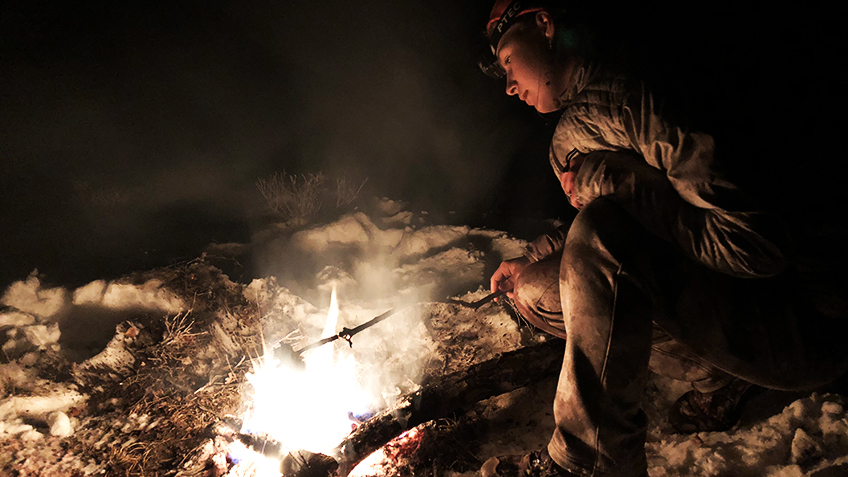
Cow Elk, 458 and 488 Yards
• Angle: kickoff shot, broadside; 2d shot, quartered away
• Bullet: 143-grain Hornady ELD-Ten
• Wind: Negligible
Now thirteen years old, my girl Cheyenne capitalized on a fast elk hunting opportunity by running forward, flopping down in 8 inches of fresh snow, and dialing to the range I called out. Her first shot took the broadside cow about ten inches behind the shoulder crease, traveling through the liver and diaphragm to finish under the hide. The elk and so ran a short distance and stopped quartered abroad. Cheyenne's second shot at 488 yards took the elk at the concluding rib and angled forward through liver and lungs to stop under the skin just ahead of the shoulder pucker. The elk staggered and went downwards. Both bullets were well mushroomed, with the bullet from the second quartered shot a bit ragged from solid contact with rib basic. Approximately 16 seconds elapsed between offset impact and collapse.
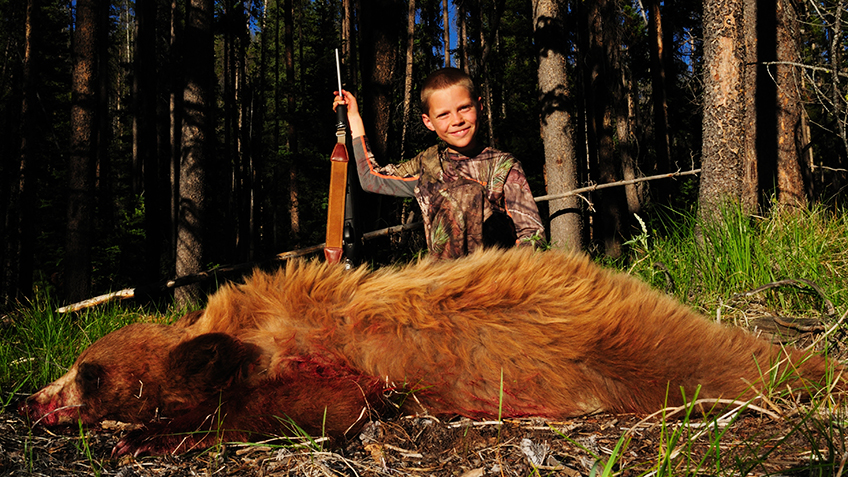
Black Conduct, 70 Yards
• Angle: broadside
• Bullet: 120-grain Federal Trophy Copper
• Wind: negligible
Sunset fell in Idaho's high country every bit my then-11-twelvemonth-onetime son, Ivan, drew down on a small blonde boar. His shot was perfect, marking his very first kill, and the first-ever animal harvested with the and then-new 6.5mm Trophy Copper projectile. It was an awesome moment. The bullet impacted perfectly on the rearward portion of the behave'south shoulder and exited exactly opposite, leaving a 1.5-inch leave pigsty. The comport dropped in its tracks, gave one or ii twitches, and lay even so.
Whitetail, 300 Yards
• Angle: quartered away
• Bullet: 125-grain Winchester Deer Season XP
• Air current: negligible
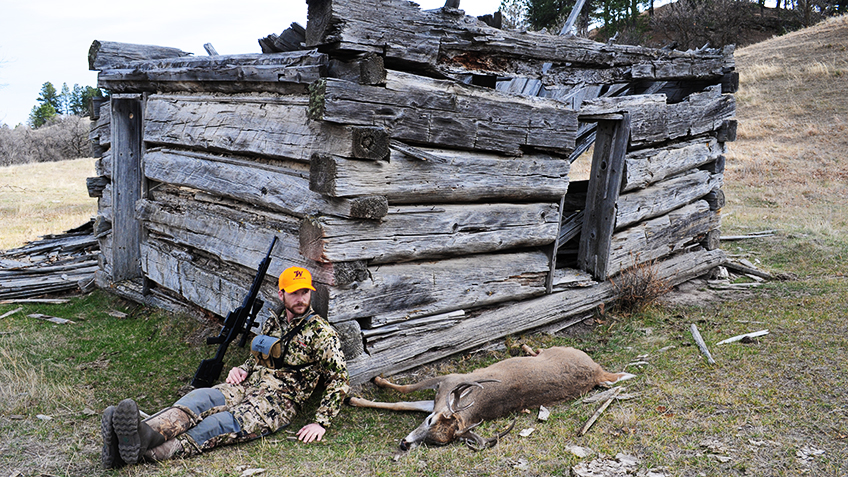
Fourth dimension for a debacle, you say? Well, hither you go. I was prone behind my hunting pack, trying difficult to get a shot at a nice 8-point buck that was sneaking up a steep patch of Wyoming hillside; trying besides hard, as it turns out. The buck paused at correct around 250 yards, I put pressure on the trigger, and so he bounded away up the hill. The fire alarm was now ringing loudly in my caput, and my wits abandoned me as the cadet slowed to a trot at something like 300 yards, steeply quartered away. I broke the shot, leading but alee of his chest. My pb was perfect, but I forgot to recoup for the additional yardage. Had I held half-dozen inches higher, the shot would take been perfect; as information technology was, the bullet bankrupt the bucks femur, opened a long angular furrow across his brisket, and the last fragment—the base—stopped against the opposite front leg bone where it joins the shoulder. That began one of the longest, hardest tracking jobs of my life. Just over 24 hours and one.v miles later, I plant the buck dead. Poor judgment and poorer shot placement was to blame for that debacle, not the six.5 Creedmoor.
Bull Elk, 202 Yards
• Angle: quartered toward
• Bullet: 143-grain Hornady ELD-X
• Current of air: negligible
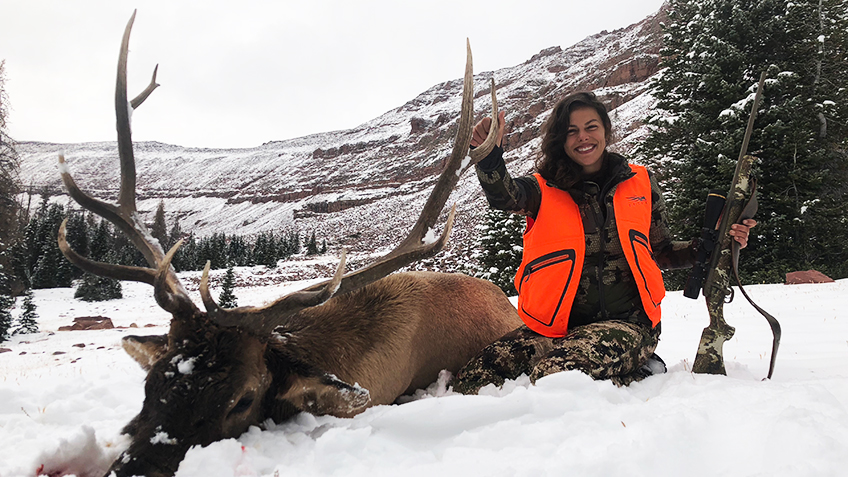
Xv miles into the backcountry, my friend Natalie and I followed steaming-fresh bull elk tracks through new-fallen snow. At that place he was, a mature balderdash running hard through alpine timber. As he flashed into an opening, I cow-called aggressively, bringing him to a sliding halt. Natalie swan-dived into a pes of snow and shot over my pack, placing a perfect shot on the betoken of the balderdash's shoulder. He lurched, ran virtually fifty yards through sparse timber, and stopped, legs spraddled out similar a sawhorse. We could encounter him, only didn't have a clear shot. He and so staggered out of the timber, swayed and crashed into the snow. The bullet had smashed through just above the heavy joint of the shoulder, taken out both lungs, and stopped somewhere in the rearward portion of the reverse ribcage. Approximately 45 seconds elapsed between impact and collapse.
Mule Deer, ninety Yards
• Angle: broadside
• Bullet: 143-grain Hornady ELD-X
• Current of air: negligible
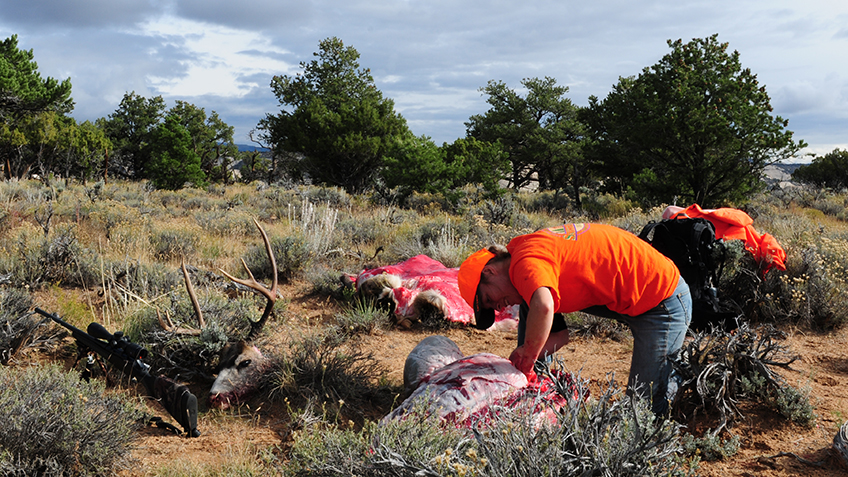
A stream of deer crested the mesa top, moving steadily across a sage-covered flat. My wife, Trina, sat with her burglarize rested on summit of my upright Badlands 2200 pack, waiting for a fat buck. Antler tips showed higher up the mesa edge, announcing a prissy buck's inflow. Every bit he crossed the sage opening in front of u.s.a., he hesitated, and Trina dropped him in his tracks. The bullet took the buck loftier through both shoulders and across the bottom of the spine, mangling the lungs in the procedure, and stopped nether the skin on the reverse side. Information technology was in several pieces from contact with then much bone, but it fabricated the cadet very expressionless very fast.
Conclusion
While the seven stories above simply tap the surface of my experience with the 6.v Creedmoor, they're consistent with my observations across a wide number of in-the-field, real-world big-game harvests. Universally, every well-striking brute I have seen has expired cleanly and rapidly. Granted, larger, heavier calibers volition hit harder and will put big, heavy animals like elk downward slightly faster than the Creedmoor. But having seen a double handful of elk killed with the cartridge, I firmly believe that information technology is adequate for wapiti.
Due to its mild recoil and inherent accuracy, the Creedmoor is ideal for recoil-sensitive or pocket-sized-framed shooters. It'southward easy to shoot well, and thus naturally lends to accurate shot placement on large game. It's chambered in a bewildering array of rifles from every American and near overseas manufactures, and a vast selection of projectiles suitable for everything from prairie dogs to elk is bachelor at every corner sporting goods shop. The 6.5 Creedmoor is, in my stance, the electric current American all-star hunting cartridge.
Source: https://www.americanhunter.org/content/6-5-creedmoor-proven-how-does-it-actually-perform-on-big-game/
Posted by: mallarduntes1948.blogspot.com
0 Response to "What Animals Can You Hunt With 6.5 Creedmoor"
Post a Comment